William's home for discarded gems and concepts-in-progress.

Welcome to William Van Winkle's blog, home for everything from notes on his latest ebooks to leftovers from his articles in CPU, Tom's Hardware, Smart Computing, and other media outlets. Check out his author pages at Amazon and Smashwords!

Monday, November 28, 2011

Being Deaf to Negativity


My Granddad encouraged me to read the classics of self-improvement during my teen years: Dale Carnegie, Norman Vincent Peale, etc. Somehow, Napoleon Hill was omitted from his roster. I'm finally reading (listening to) it for the first time now in the abridged version, although I'm liking it more than enough to go back for the five-volume work that was originally commissioned by Andrew Carnegie in 1925.

I came across a story in the book tonight that I thought I'd share with all of you. It's timely for the holidays. The author, Hill, was in a department store one day, standing in line at the customer service station. Before and behind him were mostly women, blazing with rage about some product or service that had gone bad. Hill describes the vitriolic hate that these patrons were heaping upon the lone customer service rep tasked with addressing their complaints. One after the next, these patrons would be hateful, irrational, and outright insulting, but the service rep met each of them with a smile, responded with care, and attentively sent each patron on her way to get a resolution. While each patron was busy spewing forth with her tirade, another employee sat behind the service rep taking notes. At some point before the end of the exchange, the note taker would pass a sheet to the service rep.

This greatly intrigued Hill, who admired the service rep's grace, charm, and patience. He sought out the manager and inquired about it. The manager explained that the service rep was stone cold deaf. She couldn't hear a word anyone was saying to her. The woman sitting behind her was taking notes on everything each patron was saying -- minus all of the invective and expletives. It was this note that the rep was using to guide the patron to a final resolution. Choosing a deaf person for the job was necessary, explained the manager. No one else could do it.

We all can benefit from more patience and willingness to hear the real story rather than the emotional obfuscation layered on top of it. I in particular need to take this lesson to heart, but perhaps it's something that all of us can keep in mind during the month ahead.

Tuesday, November 15, 2011

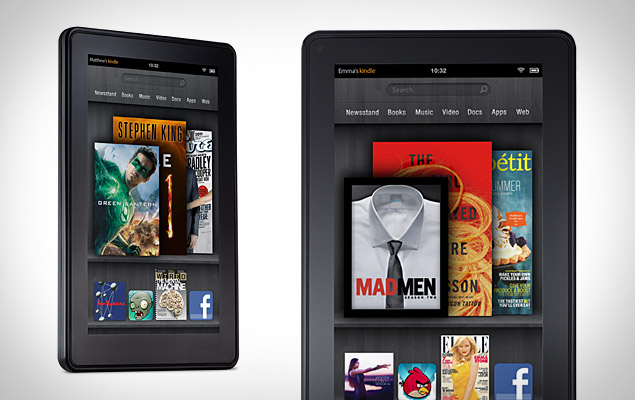
Amazon's Kindle Fire: So Misunderstood

My Kindle Fire arrived this afternoon, and now, after about two hands-on hours, it's time for some initial impressions.


But first, my dismay -- not with the device, but with the legions of online critics who had already written off the unit even before its launch. Their complaints often fall into a few buckets:


1. It's not an iPad. Very true. The iPad is 10 inches to Fire's seven, and the bigger screen is clearly preferable for watching movies. The iPad has a faster processor, a vastly more extensive app community, a better operating system, and triple the price tag, give or take. I agree with all of these points. However, Amazon wasn't trying to take on the iPad in the first place. The comparison is like condemning a Honda Civic because it's not a Lexus. Well...duh.


2. It lacks both a microphone and a camera (or two). I don't want a camera on my reading device. My smartphone has a camera. My PC has a camera. I don't need another freaking camera. I don't even like videochat in the first place. Not only does this omission leave Amazon room to grow its Kindle feature set later, but it keeps the device more focused on content enjoyment and not on interactive communication. This is a theme you'll see pop up once or twice more.


3. It only has 8GB of internal memory and no SD card slot for memory expansion. Right, so let's back up. Say you're Amazon. You've invested billions of dollars into building out one of the biggest cloud computing infrastructures and services on the planet. You host books in the cloud, store music in the cloud, stream movies from the cloud. You know beyond question that cloud computing is the future, and you want everyone everywhere to get used to relying on your cloud services, which, by the way, work amazingly well. So you build a content consumption device as a pipeline to these cloud services first and still provide some resources for local storage second. Yet many people insist on saying, "Why isn't Amazon building its device like every other tablet -- for local storage?" Because it's about the cloud, stupid. If you're not down with the cloud model, go buy something else.


4. The Kindle Fire is more expensive than several cheap, crappy Android tablet alternatives. This is also true. And for anyone who wants poor screen quality, no content ecosystem, no support, and the build quality of a pizza box, I say to you verily,  "Go for it."


The Kindle Fire lacks GPS, but being something of a privacy paranoid, I'm not sure this is a bad thing. (It still runs Google Maps without issue via the "Silk" Web browser, which will allegedly grow faster as Amazon logs users' browsing habits and strategically caches more pages.) In fact, my only hardware complaint is the omission of Bluetooth. I would like the ability to listen to audiobooks on my headset rather than wired headphones and perhaps add a wireless keyboard and/or mouse for use with Google Docs.


Speaking of which, Amazon's app store doesn't offer Google Docs or Dropbox, two services on which I depend every day. Fortunately, Amazon offers a free download of Quickoffice Pro, which not only ties right into both of those services but also Box, SugarSync, and others. It allows for easy viewing and editing of your Word and Excel files, PDFs, and more. As a writer, this will allow me to keep my Kindle Fire in my bag as a work tool and often leave my notebook at home.


Most of you don't care about this. You want to know about the experience of enjoying content on the device. So here are some initial impressions:


1. With a 1024 x 600 display, text and graphics look awesome. I've now put several books on the Fire, and they all look incredible, although my wife has to dial down the brightness quite a bit to be comfortable. I haven't tried any "enhanced" (interactive, animated) books yet, but I'm confident they will be quite satisfying. Are we taking a forward with color but two steps back by eliminating E Ink? For some, perhaps. I prefer the backlighting because most of my reading is done in a dim room before bed. My wife is more sensitive to light and prefers the more natural look of E Ink. If your principle use for a Kindle is ebook reading, then the monochromatic design may make more sense and save you $100 in the process. Personally, I prefer having more flexibility for a wider range of content.


2. The sound comes from two speakers in the top edge. I recommend digging into the EQ settings and choosing Rock for the best mix of bass and mid-range, but when I say "best," keep this in perspective. These are not Bose speakers. They sound worse than even the $10 beer can speakers included with $299 PCs. But they're better than nothing, and you even get something of a "wide" stereo effect. Unfortunately, this doesn't count for much when you rotate the Fire 90 degrees to watch movies.


3. I tried out the Prime free movie service, which is way simpler to use on the Kindle Fire than on any other Amazon-friendly device I've sampled (such as Google TV). In under 10 seconds, I had the movie Speed streaming at TV-level image quality. No dropped frames, no audio hiccups. Mind you, this was across the house from my router with only one Wi-Fi bar showing. That's pretty impressive.


4. I went to the Kindle Owner's Lending Library and checked out a book. It's really idiotproof. Just hit the button to borrow the title, exactly as you would to buy it. The book downloads in a few seconds and shows up in your library. If you try to borrow another one, you'll see a note saying that you've reached your borrowing limit for the month. You don't have to "give" the book back in 30 days, but you won't be able to check out another until the following month and you return the checked out title. The brilliance of this Lending Library is insidious. If you're enough of a reader to go through one ebook per month, and the average ebook costs, say, $6 or $7 each, then Amazon is giving you roughly $70 to $80 of free ebook enjoyment per year -- if you own a Kindle and subscribe to the $79/year Prime service. Mind you, Prime brings with it thousands of free streaming videos plus free two-day shipping on all Amazon-stocked physical goods orders. Amazon gives you a free month of Prime when you register the Fire, just to get you hooked. Now, I'm a Prime "guest" user on my wife's subscription, so I get the free shipping benefits already, but I don't get the Lending Library or videos. Will it be worth my family paying another $79/year for two full Prime memberships in order to get the extra benefits? This remains open to debate.


5. I went to my public library's site and borrowed a Kindle book. When I send library books to my Android phone via Kindle Manager, they arrive in only a few seconds. With the Kindle Fire, you have to go into the settings menu and hit Sync. It took me a few minutes of waiting for the books list to (not) refresh before I figured this out.


6. Overall, the Fire's interface is friendly and intuitive. I'm not crazy about how the home screen is dominated by a cascade of huge tiles showing your most recently open items. Once you've opened a couple dozen books, apps, songs, etc., it gets fairly cumbersome trying to scroll through these. Similarly, there isn't enough room in the Favorites area to stack your most commonly used items. I quickly found myself relying on the tabs across the top of the screen: Newsstand, Books, Music, Video, Docs, Apps, Web. This entails more tapping and hunting than if the Fire would have had a usual Android desktop, but it is what it is. I hope Amazon improves this soon.


Overall, the Fire is everything I'd hoped for. It's a solid, high-quality, easy, and dependable pipeline to the cloud services I want. Also, I should point out that I own a Nook Color. The Nook is a good device and in some ways better than the Kindle Fire. However, I've held off on buying much content for it because, as a book lover, I still have this crazy idea that I'll "own" my book collection decades from now and be able to let my children and grandchildren enjoy the purchases I'm making today. Whether deluded or not, this begs the question: If I'm going to invest hundreds or even thousands of dollars into content in the coming years, which platform do I trust to be around for the long haul: Nook or Kindle? 


After that question, these ridiculous quibbles over SD slots and memory seem entirely misguided and short-sighted.

Monday, November 7, 2011

Read It and Weep: The College Textbook Shakedown

Reader Jenica Rhee noted by Rewriting the Textbook Market? Smashing! post over on my Architects of Tomorrow blog, which is devoted to my tech leader interview books. She offered me the following infographic (permalink here), and I found it too fascinating to resist. If you've ever wondered why college textbooks are so insanely priced and why change is so slow to come to this market, read on...

Textbook Shakedown
Via: OnlineEducation.net

Friday, November 4, 2011

My Final Bank of America Experience

Bank of America Plaza - Atlanta, GA
It is done.

After several years and six accounts, I have closed everything I had going with Bank of America, save only for the lingering credit card, which will be switched as soon the new one comes through at OnPoint Credit Union. I had this switch-over in progress before I became aware of November 5th being Bank Transfer Day. My own switch happened today by coincidence.

I felt guilty while sitting down with the B of A rep. She was a charming young lady of about 30, and she began with the usual spiel about, "Oh, I'm so sorry to hear you'll be leaving us. Is there anything we can do...?"

No, the time for that is long past. From the sudden appearance of checking account fees in 2008-2009 to those fees increasing without notice to the recent $5 swipe fee debacle, all I see from B of A as a service vendor is an unending string of nickle and dime extractions meant to squeeze every electron of economic energy possible from we coppertops. None of these fees have ever provided me with a positive customer experience or service enhancement. None.

So I told the lady, "Every single employee I've ever dealt with at B of A has been exemplary in terms of kindness and helpfulness. It's your company that I can't stand anymore, and I'm taking my money to a place where profits are given back to regular people."

Something in her look told me I could ask another question so I did. "The bonuses that banks pay out every year," I said. "Do all employees get a bonus, or only the executives?"

Her features hardened and she leaned back. "Just the executives," she said. Then, "No, that's not true. On years when we surpass quota, the employees get a bonus. I get $250. But it's taxed as a bonus, so I see...maybe $100 of it. For the year."

In contrast, Bank of America CEO Brian Moynihan drew $9.05 million in stock awards earlier this year. That's on top of his $950,000 salary.

I asked my banker how much bank employees make. She shook her head ruefully.

"Tellers start at $10 an hour," she said. "They go up to $12. A personal banker might make $13 or so an hour. The assistant manager could do $15 -- $17 tops." A mixture of anger and fear crept into her voice, and I could tell that times were tough for her, even having a job at which she worked six days a week. "You know, I drove by Carl's Jr. the other day, and they're hiring at $12 an hour. You would think that the people you're trusting with your thousands of dollars would get paid more than just a couple of bucks over minimum wage."

You would think.

I took my final cashier's check across the street to OnPoint Credit Union and deposited it in my new account. I asked the teller how much they make.

"We start at $15 an hour," she said smiling. "And the insurance? I have to pay more for my family -- 20% of the premium for my kids -- but just for me? I'm 100% covered." Then she added, "I worked for Bank of America 30 years before coming here. I don't miss them at all."

So I feel better. Not just because I took my money away from an insidious, corruptive, blood-sucking juggernaut. (I mean really, do you seriously think that B of A won't find a quieter way to extricate that $5 pound of flesh from its customers every month?) I feel better knowing that the profits made from my money for the credit union will not only go toward keeping loan rates low for clients, they'll also provide a better quality of life for the employees who work hard every day and deserve a decent paycheck.

If you want to walk the walk, if you want to help the few financial institutions that don't seek to twist laws for their own profits, that create good jobs, that are trying to help you and not drain you into poverty, put your money in a credit union. Yes, I know it's a pain to switch all of your stuff over. Yes, you'll need to print out and/or save all of your records, because banks like B of A will kill off all of your online records access on the same day you close your accounts. But please...it's worth it. I'm OK with enduring a week or so of inconvenience for a much greater good.

Sunday, October 23, 2011

The Value of College...Questioned

According to the Department of Education, no more than half of those who started college in 2006 will have a four-year bachelor's degree within six years. So says a May 15, 2010, article in The New York Times. This story makes a compelling case for why an increasingly expensive college education may no longer be the right choice for everyone looking to enter the American work force. "College degrees are simply not necessary for many jobs," notes the article. "Of the 30 jobs projected to grow at the fastest rate over the next decade in the United States, only seven typically require a bachelor’s degree, according to the Bureau of Labor Statistics."


Three days after this article was published, a counter-view went live, and the crux of the critic's point is seen in this chart. The author states, "I think the answer lies in the most straightforward data of all: the relative pay of college graduates and everyone else."


This data arrives via the Bureau of Labor Statistics, and it examines median weekly pay for "the four main educational-attainment groups going back to 1979."


The author sums up, "As you can see, the real pay of college graduates has risen over the past 25 years. The real pay of every other group has dropped."


I'm not arguing against college education, but let me point something out. Yes, this data shows that college graduates are faring better than their non-graduate counterparts. But real weekly income for graduates went from about $950 in 1979 to $1,150 in 2009. This is a 21% increase over 30 years. I went to the US Inflation Calculator and learned that cost $100 in 1979 would cost $295.51 in 2009, an inflation rate change of 195.5%. It's fair to say that the year-over-year benefits of a bachelor's degree pale against the rising tide of general cost increases.


In 1979, the cost of a year of undergraduate education at the University of Pennsylvania was $5,270 for tuition and general fees. (Let's ignore room, board, etc.) Roundly speaking, that's $21,000 for a four-year education. If I had invested $21,000 into the S&P 500 index fund in 1983, it would have grown to $154,938 by the end of 2009, according to the stock market CAGR calculator at Moneychimp. That's adjusted for inflation. The unadjusted total would be $341,250.


Again, I'm not suggesting that all of the money poured into a conventional education might be better poured into long-term investments. But this certainly provides a different look at return on investment and might give some people additional pause to wonder if the current cost of a degree will truly be worthwhile. In some fields, the answer probably remains a resounding affirmative. But if I had my English degree to do all over again, I'd just pocket the cash, sink it into an index fund, and be better off for it. On-the-job experience and hard work has proven far more beneficial.

Monday, October 17, 2011

Why Your Parents Didn't Need to Occupy Anywhere

For the last two years, I've been collaborating on a personal finance book called "Where Does It All Go?" (now entering third draft). Chapter 1 opens with a discussion about how many people live with the frustration of feeling that they have things worse than their parents or grandparents did, and surely this must be due to their own inadequacies and failings. As the Occupy protests and the many, many personal testaments on We Are the 99 Percent show, this sense is widespread and far from unfounded. It is much harder for Americans now than it was a generation or two ago.

In the book, my colleague and I detail four primary ways in which this is true. But sometimes, a single picture can be worth more than a long chapter passage, especially if that picture is interactive.

I came across The State of Working America site this morning and its interactive look at "When income grows, who gains?" There are many reasons why today's generation is worse off than its predecessors, and in the book, we don't even touch on what this graphic so profoundly illustrates: Most if not all of the economic growth in America is not going to 90% of the population.

The graph's total data spans from 1917 to 2008. I picked the segment from 1950 to 1975. This was the prime of my grandfather's life, after he'd served in World War II, received G.I. funding through a Master's in Business at Harvard, and started his professional career. In this 25-year span, his family went through periods of boom and bust. I've heard stories of holidays where the kids got little more than fruit, and I know they came to Oregon in the late 1960s with barely $5,000 to their name. But my grandfather worked like mad, paid his fair share, and it all worked out.  He lived in a world where advances in the overall economy fell across all demographics. They ate well, took vacations, built up savings, owned their homes, and always had good health care.

As you can see, in my grandparents' time, the richest 10% of the country only got 30% of the growth. The other 70% went to the 90% masses -- people like us.

This is my generation, today. I started my career in 1990. In my generation, the masses got only 5% of the growth. Everything else went to the 10% richest, and, as you can see, the top 1% took nearly all of that.

The truly disturbing aspect of this chart is not today's disparity between the top 10% or even 1% and everybody else. The really scary part is that the top 1% are experiencing exponential growth. Look at the general shape of the curve. That's not linear. It's exponential, and you can see the "knee" of the curve happen in the early 1980s, as President Reagan started relaxing many of the old restrictions on businesses. Those who controlled the businesses were able to profit immensely and gather nearly all of the growth to themselves, leaving the 90% to combat inflation in whatever ways they could find. This has left us with everything from emergency rooms overstuffed with the uninsured (supposedly) middle class to a nation ballooning in obesity from cheap, carbohydrate-laden foods.

Exponential growth is unsustainable in any closed system, and it's obvious to anyone with eyes that the current trend cannot last much longer. My deep hope is that the primary world governments will recognize this and see the Occupy protests for what they are: a wake-up call to the dangers of this trend, not the whining of some allegedly idle, rabble-rousing losers. The media, of which I am professionally a part, has been reprehensible in its disdain for the protesters. And yes, on the whole, the protests are disorganized, diffuse, and sometimes incoherent. But that doesn't make them wrong.

We need to see the trend, hear the rising sentiment, and appreciate that these protesters have gone to great lengths in the face of their own economic adversities to remain peaceful. This is possibly a last chance to listen, to "get it." Because if these protests peter out and we see more years of this exponential rise in the super rich while the general population is left to flounder and stagnate, the outcome is inevitable. Centuries of history show repeatedly and invariably that the only possible result is rending, tragic violence that no amount of money can contain.

Sunday, October 2, 2011

Amazon Looks to Burn Out Apple's Roots

Has it been so long that we've forgotten how Apple managed to maintain a foothold in the computing market at a time when the Microsoft/Intel duopoly was virtually universal? It was schools. Before aluminum unibody iBooks and even berry-colored iMacs, Apple has always made sure that it had mindshare in the education market. One could argue that it was this precedent that set the stage for today's shift to adopting iPads in modern classrooms.

Not the average classroom, of course. Not in districts like mine suffering from a $22 million budget shortfall. But in some universities and private/independent schools and, OK, maybe some fortunate public K-12s, teachers are looking to embrace the future and get their kids ahead of the curve. You're even starting to see education courses appear on how to use iPads in the classroom.

Why aren't all schools hopping on the iPad wagon? No doubt, there are many reasons, ranging from IT management concerns to outright pigheaded technophobia. But one of the top inhibitions has to be the $750 average price per device I wrote about earlier this year. When districts have to start implementing "budget closure days" in order to balance their bottom lines, who has $750 for every student to get a new tablet? There are roughly 55 million American elementary and secondary school students. Figure in a small group discount, and that's about $40 billion in iPads.

But along comes the 7-inch, Android-based Kindle Fire at $199. Suddenly, our budget to outfit every first through 12th grader drops to $11 billion. For reference, this is about the going rate for one month of U.S. war in Afghanistan and only slightly more than the bonus pay received by JP Morgan investment bankers in 2010.

So does it seem feasible that we as a country that still allegedly values its future could find a way to give our students each a tablet? I'd like to think so. If that sounds too entitled or socialist, fine. For $199 a pop, I'd find a way to come up with the money for each of my two boys. All I need to see is that the apps and content are there to make it worthwhile. (And sure, having teachers and administrators with a clue how to make use of current technology would be a great bonus.)

This brings us to the root of my point: I have yet to see anyone in the press discuss the Amazon Kindle Fire as an educational device in the same way that the iPad is now being touted, but in this regard I really think Amazon may have an iPad killer in the works. Do students need a camera or 3G wireless connectivity in a tablet? No. Those who want such things already have them in their phones. Do kids really need the bigger screen for virtual keyboard typing? No. You can create notes on a screen well enough, but serious content creation still demands a mouse, keyboard, and more pixels than you're going to cram into even 10 inches. And as someone who owns both a 10" Android tablet and a 7" NOOK Color, I can vouch for the fact that a 7" form factor is far more convenient. All it took was one business trip with both devices, and the 10" has stayed home ever since.

Yes, the Kindle Fire is being sold at a few bucks under Amazon's manufacturing cost in order to hit that tantalizing $199 price point, because Amazon knows it will make up the money on content purchases made through the device. But check out Amazon's Android app store, which I find far preferable to the chaos of the conventional Android Marketplace. I'll wager that the 1,125 educational titles now listed in Amazon's store will grow by several times over the next year. Amazon already has a full-blown textbook division, complete with a Kindle-based rental sub-site. And does it matter that the Kindle Fire doesn't have expandable storage when all of your purchases can be stored on and streamed from Amazon's Cloud Drive for free?

The only drawback I see here is that slowly yet surely, those who ride the Amazon education train will become locked into Amazon's platform. The other day, I picked up my old high school American History textbook to check a fact. In 25 years, if my kids want to do this, they might have to be paying to make sure they can still access their Amazon digital content. This rankles, but I also think it's inevitable as the world gradually, increasingly makes premium content, including books, into a subscription service. Whether you pay Amazon or Apple or Microsoft or whatever other mega-providers emerge in the future, you're going to pay someone as sure as you pay the utility companies today. But I digress.

I want my kids, and all kids, to have a tablet as part of their everyday learning and curriculum. Google was unable to take the wind from Apple's sails in this regard because it didn't have any control over the hardware ecosystem. Amazon has now remedied that problem, and in the Kindle Fire the company has an entry device into a complete content infrastructure that's tailor-made for student and educator needs. All that's left is to see the software developers leap in with the same creativity that they've shown on the iPad. Here's to hoping that Amazon will encourage them in this pursuit and recognize the educational gold mine now within its reach.