William's home for discarded gems and concepts-in-progress.

Welcome to William Van Winkle's blog, home for everything from notes on his latest ebooks to leftovers from his articles in CPU, Tom's Hardware, Smart Computing, and other media outlets. Check out his author pages at Amazon and Smashwords!
Showing posts with label singularity kurzweil daniel pink left brain education labor india humanity artificial intelligence. Show all posts

Sunday, October 2, 2011

Amazon Looks to Burn Out Apple's Roots

Has it been so long that we've forgotten how Apple managed to maintain a foothold in the computing market at a time when the Microsoft/Intel duopoly was virtually universal? It was schools. Before aluminum unibody iBooks and even berry-colored iMacs, Apple has always made sure that it had mindshare in the education market. One could argue that it was this precedent that set the stage for today's shift to adopting iPads in modern classrooms.

Not the average classroom, of course. Not in districts like mine suffering from a $22 million budget shortfall. But in some universities and private/independent schools and, OK, maybe some fortunate public K-12s, teachers are looking to embrace the future and get their kids ahead of the curve. You're even starting to see education courses appear on how to use iPads in the classroom.

Why aren't all schools hopping on the iPad wagon? No doubt, there are many reasons, ranging from IT management concerns to outright pigheaded technophobia. But one of the top inhibitions has to be the $750 average price per device I wrote about earlier this year. When districts have to start implementing "budget closure days" in order to balance their bottom lines, who has $750 for every student to get a new tablet? There are roughly 55 million American elementary and secondary school students. Figure in a small group discount, and that's about $40 billion in iPads.

But along comes the 7-inch, Android-based Kindle Fire at $199. Suddenly, our budget to outfit every first through 12th grader drops to $11 billion. For reference, this is about the going rate for one month of U.S. war in Afghanistan and only slightly more than the bonus pay received by JP Morgan investment bankers in 2010.
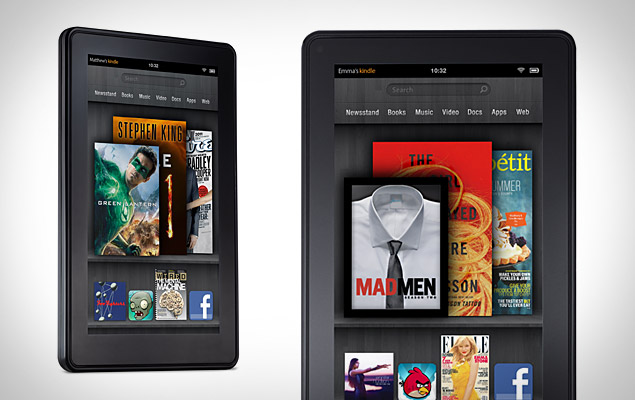
So does it seem feasible that we as a country that still allegedly values its future could find a way to give our students each a tablet? I'd like to think so. If that sounds too entitled or socialist, fine. For $199 a pop, I'd find a way to come up with the money for each of my two boys. All I need to see is that the apps and content are there to make it worthwhile. (And sure, having teachers and administrators with a clue how to make use of current technology would be a great bonus.)

This brings us to the root of my point: I have yet to see anyone in the press discuss the Amazon Kindle Fire as an educational device in the same way that the iPad is now being touted, but in this regard I really think Amazon may have an iPad killer in the works. Do students need a camera or 3G wireless connectivity in a tablet? No. Those who want such things already have them in their phones. Do kids really need the bigger screen for virtual keyboard typing? No. You can create notes on a screen well enough, but serious content creation still demands a mouse, keyboard, and more pixels than you're going to cram into even 10 inches. And as someone who owns both a 10" Android tablet and a 7" NOOK Color, I can vouch for the fact that a 7" form factor is far more convenient. All it took was one business trip with both devices, and the 10" has stayed home ever since.

Yes, the Kindle Fire is being sold at a few bucks under Amazon's manufacturing cost in order to hit that tantalizing $199 price point, because Amazon knows it will make up the money on content purchases made through the device. But check out Amazon's Android app store, which I find far preferable to the chaos of the conventional Android Marketplace. I'll wager that the 1,125 educational titles now listed in Amazon's store will grow by several times over the next year. Amazon already has a full-blown textbook division, complete with a Kindle-based rental sub-site. And does it matter that the Kindle Fire doesn't have expandable storage when all of your purchases can be stored on and streamed from Amazon's Cloud Drive for free?

The only drawback I see here is that slowly yet surely, those who ride the Amazon education train will become locked into Amazon's platform. The other day, I picked up my old high school American History textbook to check a fact. In 25 years, if my kids want to do this, they might have to be paying to make sure they can still access their Amazon digital content. This rankles, but I also think it's inevitable as the world gradually, increasingly makes premium content, including books, into a subscription service. Whether you pay Amazon or Apple or Microsoft or whatever other mega-providers emerge in the future, you're going to pay someone as sure as you pay the utility companies today. But I digress.

I want my kids, and all kids, to have a tablet as part of their everyday learning and curriculum. Google was unable to take the wind from Apple's sails in this regard because it didn't have any control over the hardware ecosystem. Amazon has now remedied that problem, and in the Kindle Fire the company has an entry device into a complete content infrastructure that's tailor-made for student and educator needs. All that's left is to see the software developers leap in with the same creativity that they've shown on the iPad. Here's to hoping that Amazon will encourage them in this pursuit and recognize the educational gold mine now within its reach.

Wednesday, February 2, 2011

From Left Brain to Post-Human

Synchronicity can be fun. It can also scare the hell out of you.

I've been listening to Daniel Pink's A Whole New Mind, and I'm at the chapter in which he looks at how developing nations, such as China and India, are rapidly catching up (or have already caught up) to the U.S. in terms of being able to handle left brain-oriented work tasks, meaning those which rely on consistent processes and linear thinking. An increasing number of large companies are outsourcing their accounting work, for example, hiring equally qualified Indian labor for less than 20% of the cost of American equivalents. 

I've been thinking a lot about such trends recently. I've been pushing my children (now ages six and nearly nine) hard to master math skills on Khan Academy and introducing them to broad science concepts. Some people think you're a tyrant just for pushing your kids to be a year ahead. I want my boys four, five, even six years ahead. Why? Because the rest of the world is hungrier and more motivated than we are. If kids abroad can be trained at this pace, they will be -- and they are. Those kids will emerge from school competing against my kids for all of those left brain jobs, and those other kids will be able to apply their accelerated educations for a fraction of the wage my kids will expect. In short, if my kids do nothing more than "meet benchmarks," if they even manage to keep pace with the kids in countries currently trouncing America in secondary education, they will still lose. There is no way my sons will be able to compete for geographically unrestricted work at $2 an hour, especially after racking up a $100,000+ college debt. The implications for American unemployment and our general economy are grim.

As if the outsourcing situation wasn't bad enough, it gets worse. Pink continues his argument, noting that software developers are creating applications able to replace even cheap foreign knowledge workers. It's the inevitable result of Moore's law. When computing becomes so powerful and inexpensive that TurboTax can effectively replace a mid-level CPA, not even Indians can compete. Pink points to Appligenics and the fact that we now have software "smart" enough to create new software. Computers are the ultimate left brain endgame. How long will it be before computers can perform contextual analysis and automatically generate the press releases some companies pay me hundreds of dollars to write?

Enter synchronicity and my in-progress interview with eminent inventor and futurist Ray Kurzweil. I interviewed Kurzweil in 2002 for my very first Q&A column in CPU magazine. Today, I'm doing a follow-up to this piece for my Architects of Tomorrow book. Kurzweil currently has a just-released movie called The Singularity is Near, based on his 2005 book of the same name. "Singularity" is a coalescing of accelerating technology trends. As Kurzweil's site puts it, Singularity is "an era in which our intelligence will become increasingly nonbiological and trillions of times more powerful than it is today—the dawning of a new civilization that will enable us to transcend our biological limitations and amplify our creativity." He's talking about the blending of humans and computers -- the chip in your head or hand or wherever it becomes advantageous. Because isn't that what it will boil down to: advantage? Some people will get such implants for enjoyment. I suspect most will get them out of economic necessity. Today, my kids need to access more knowledge in order to stay competitively relevant. My grandkids will face the same challenge on a higher order of magnitude.

When it comes to forecasting technology trends, Kurzweil has a rather amazing track record, and he has the resume necessary to avoid being taken out of hand as a quack. He believes, and the trend undeniably indicates, that computers are only a few years away from being more intelligent than humans. Both he and Pink point to the defeat of chess grandmaster Garry Kasparov by IBM's Deep Blue as writing on the wall. Kurzweil's chief area of research for the past decade has been artificial intelligence (AI), and if anyone is in a position of authority and knowledge to make such grand statements, it's him.

Kurzweil dismisses the oft-discussed risk of computers rising up against and overthrowing their human masters, as in The Terminator series, and I suspect he may be right. After all, if we bind biology and computing together, doesn't the technology become a sort of integrated prosthetic? It's not us against the machines. It's just a new, different us. And if we're bending genes in the same way we're building circuits, then it's not really so much about prosthetics as it is about changing the human form. We are racing down the path, well along the way toward turning ourselves into something else. It's pointless to pass judgment on whether that something else is better or worse. It's just different and more complex. 

I don't want to agree with Kurzweil. I find the idea repugnant. But it all makes terrible, logical, and perhaps inevitable sense. If Pink is right, then we're engaged in a left brain arms race that seems bound to lead us to Kurzweil's Singularity. The remaining question is whether computers will be able to master creativity and emotion, as well, thus migrating into the "right brain" half of our humanity. And if Kurzweil's time tables are right, if we only have 20 to 40 years left for these technology tracks to play out, what does this mean for my children and grandchildren? What can I do except continue to drive them toward a successful tomorrow...and pray?